The Weakest Link You Never See Coming: Why Your Transmission Pays the Price for Every Mod You've Made
There's a painful rite of passage in the enthusiast community that nobody really talks about until it happens to them. You've spent months — maybe years — building your car into something genuinely fast. The tune is dialed. The exhaust note is savage. You're pulling hard through the gears and everything feels glorious. Then, somewhere around third gear on a backroad in Tennessee or a drag strip in Texas, you hear a sound that makes your stomach drop. Grinding. Slipping. Silence.
Your transmission just gave up.
It's one of the most common and most expensive lessons in the performance world, and it almost always stems from the same mistake: treating the gearbox as an afterthought while everything around it gets upgraded.
Why the Transmission Always Gets Left Behind
Here's the honest truth — transmissions are boring to talk about. Nobody's posting Instagram reels about their freshly rebuilt valve body. You don't get the same dopamine hit from a rebuilt automatic as you do from a shiny new set of turbos. So builders prioritize the sexy stuff first: forced induction, cams, headers, intakes. And that's completely understandable.
But the factory transmission in your car was engineered to handle the factory power output, maybe with a modest safety margin built in. The moment you start pushing significantly beyond those numbers, you're borrowing time. The gearbox doesn't care how good your tune is or how much you spent on your intercooler. It just knows it's receiving more torque than it was ever designed to manage.
The Physics Nobody Explains at the Parts Counter
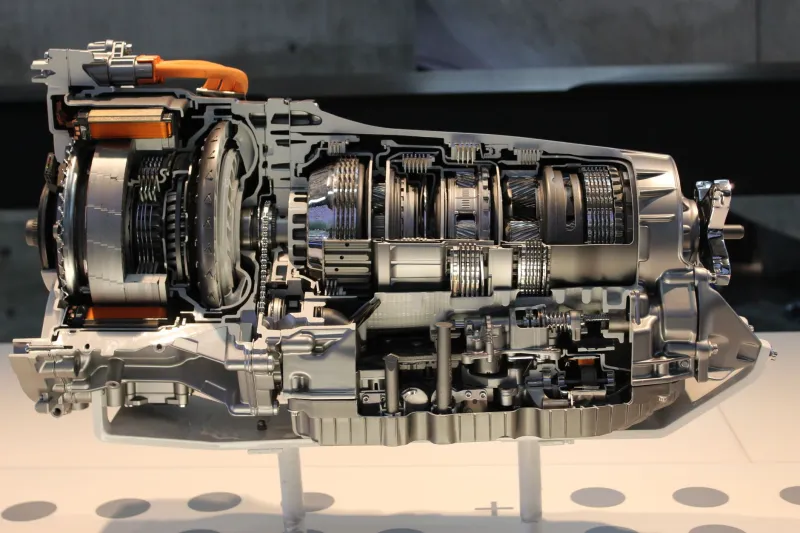
Torque multiplication is the concept that bites people hardest. When you add a turbocharger or supercharger, you're not just adding horsepower — you're dramatically increasing the rotational force being fed into the drivetrain. That force gets amplified through the torque converter or clutch assembly before it ever reaches the transmission's internal gears and clutch packs.
A stock 5.0 Mustang, for example, produces around 420 lb-ft of torque at the crank. Bolt on a Whipple supercharger and a proper tune, and you might be looking at 650, 700, even 750 lb-ft depending on the build. The 10-speed automatic that came in that car from the factory? It was designed with a specific load ceiling in mind, and you just blew past it.
The clutch packs inside an automatic transmission are particularly vulnerable. Under sustained high-torque loads — especially during hard launches or repeated wide-open-throttle passes — they generate heat faster than the fluid can dissipate it. Once the fluid breaks down, friction material degrades, and that's when the slipping starts. Slipping generates more heat. More heat accelerates wear. You see where this goes.
Real Builders, Real Carnage
Talk to any serious builder at a track day and you'll hear these stories firsthand. A builder in the Midwest running a built LS-swapped Camaro pushed his 4L60E past 600 wheel horsepower before the transmission finally let go on his third pass of the day. He'd spent close to $14,000 on engine work and maybe $200 on a shift kit. The rebuild cost him $3,800 and two months of downtime.
Another enthusiast running a modded EVO X in the Pacific Northwest kept snapping input shafts in the factory dual-clutch transmission after adding a larger turbo and aggressive launch control settings. The OEM transmission simply wasn't built for the shock loading that hard launches produce, especially with sticky drag radials transferring all that energy almost instantaneously.
These aren't edge cases. They're the norm for anyone who builds power without building supporting infrastructure.
Recognizing the Warning Signs Before It's Too Late
Your transmission will usually tell you it's struggling before it completely fails — if you're paying attention. Delayed engagement when shifting from park to drive, especially when the fluid is warm, is an early indicator. Subtle slipping between gears under hard acceleration — where the RPMs spike without a corresponding increase in speed — means the clutch packs are already losing their grip. Burnt-smelling transmission fluid is a red flag that should never be ignored. Dark brown or black fluid means the thermal breakdown has already been happening for a while.
If you're running a manual, watch for clutch chatter on engagement, difficulty finding gears under load, or synchro grinding that wasn't there before. These symptoms mean your clutch or synchros are overwhelmed.
Budget-Tiered Upgrade Path: What to Consider
The good news is that you don't have to be building a 1,000-horsepower race car to justify a transmission upgrade. Here's a rough breakdown of where your money goes at different build levels.
Entry Level ($500–$1,500): At this tier, focus on supporting mods rather than a full swap. A quality transmission cooler is arguably the single best investment you can make before anything else — dropping fluid temps dramatically extends component life. Pair that with a fresh fluid service using a high-quality synthetic like Amsoil or Redline, a shift kit to firm up hydraulic pressure, and a deep pan for increased fluid capacity. For manuals, a quality aftermarket clutch kit from brands like Southbend or ACT is your priority.
Mid Range ($1,500–$5,000): This is where you start getting into rebuilt or upgraded units. For popular GM applications, a rebuilt 4L80E with upgraded clutch packs and a billet input shaft is a proven solution that handles big power reliably. Ford 10-speed owners building serious power should be looking at Gearstar or similar performance-built units. Tremec's T56 Magnum is a perennial favorite for manual swaps in this price range, rated to handle up to 700 lb-ft when properly installed.
Full Send ($5,000+): At this level, you're looking at full billet builds, transbrake-equipped units for drag applications, or purpose-built performance automatics from shops like ATI, Rossler, or TCI. If you're making serious power and actually using it at the track with any regularity, this isn't optional — it's infrastructure.
Build the Whole Car, Not Just the Engine
The performance community has a saying that gets thrown around a lot: there's no replacement for displacement. But there's another truth that doesn't get nearly enough airtime — there's no point in making power your drivetrain can't survive.
Every dollar you put into your engine is a dollar that eventually has to be backed up by the components downstream. The transmission is the bridge between your engine's ambitions and your rear wheels' reality. Ignore it long enough, and it will find a way to make itself impossible to ignore — usually at the worst possible moment and at the worst possible cost.
Plan the transmission into your build from the beginning. Budget for it. Research it. Talk to other builders who've run similar power levels. The enthusiasts who consistently build reliable, fast cars aren't the ones who chase horsepower numbers obsessively — they're the ones who think about the whole system.
Your gearbox isn't the glamorous part of the build. But it just might be the most important one.