Running Hot: The Cooling System Upgrades That Separate Serious Builders from Sunday Drivers
Here's a truth nobody puts on a dyno sheet: horsepower is just organized heat. Every time your engine makes power, it's also making an enormous amount of thermal energy, and your job as a builder — or at least the job of your cooling system — is to get rid of that heat before it turns your expensive internals into a very sad paperweight.
Thermal management is one of those topics that gets buried under flashier upgrades. Nobody's posting about their new aluminum radiator on the enthusiast forums with the same energy they'd bring to a supercharger reveal. But ask any serious engine builder, and they'll tell you the same thing: if you're not managing heat, you're not really building a performance car. You're just building a time bomb with good aesthetics.
Let's talk about what actually works, what's mostly marketing, and how your local climate might be dictating your build priorities more than you realize.
Why Stock Cooling Systems Fall Short
Factory engineers are working with constraints most of us don't think about. They're balancing cost, packaging, emissions compliance, warranty exposure, and the assumption that the average driver isn't going to spend three hours at a track day in Phoenix in July. Stock cooling systems are designed for a statistical average — and if your driving falls outside that average, you're already asking more of your cooling system than it was built to give.
Add power — whether through a tune, a turbo, nitrous, or forced induction of any kind — and the thermal load compounds fast. More combustion energy means more heat rejection required. Stock radiators, stock oil coolers, and stock intercoolers weren't sized for that math. They were sized for a car that leaves a subdivision, merges onto a highway, and parks at an office building.
Radiators: The Foundation of the Whole System
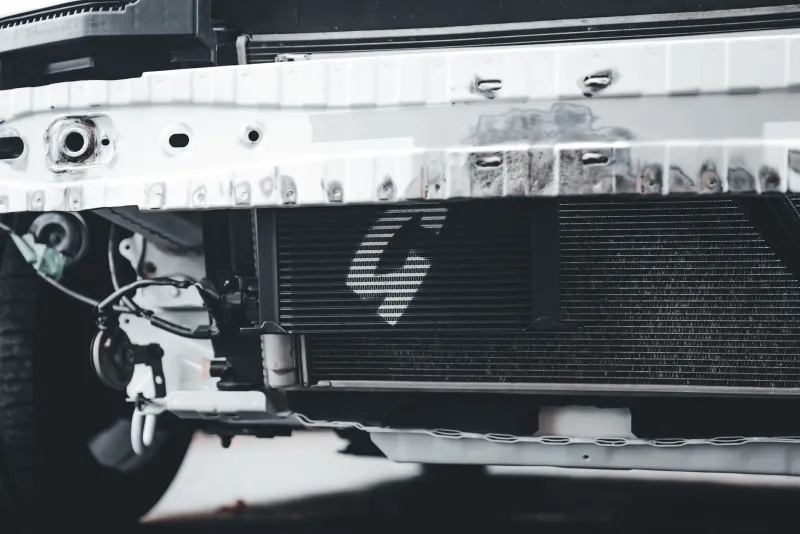
If you're building for performance and you haven't thought about your radiator, start here. Upgrading to an aluminum performance radiator — typically with a larger core and more efficient tube design — is one of the most straightforward thermal improvements you can make. Companies like Mishimoto, CSF, and Koyo have options for most popular platforms, and the improvement in cooling capacity is measurable, not theoretical.
The key specs to focus on are core thickness and the number of rows. A thicker, denser core moves more coolant through more surface area, which means more heat gets transferred to the air passing through. Pair that with a quality fan upgrade — or at minimum, verify your factory fan clutch isn't worn out — and you've built a solid foundation.
For track-focused builds in hot climates like the Southeast or Southwest, this isn't optional. It's table stakes.
Intercoolers: The Forced Induction Wild Card
If your build involves a turbo or supercharger, your intercooler is doing some of the heaviest thermal lifting in the whole system. Charge air coming off a compressor is hot — sometimes extremely hot — and the intercooler's entire job is to cool it down before it enters the combustion chamber. Denser, cooler air means more oxygen, which means more power and better knock resistance.
Front-mount intercoolers (FMICs) are generally the go-to for serious builds because they sit in the path of maximum airflow. Top-mount setups, common on a lot of factory turbocharged cars, are more compact but tend to heat-soak faster under sustained load. If you're doing more than occasional spirited driving, an FMIC upgrade is usually worth the extra plumbing work.
Water-to-air intercoolers are another option gaining traction, particularly in supercharged applications where packaging a front-mount isn't feasible. They're highly efficient, but they introduce a secondary cooling loop that adds complexity. Great for drag applications. A little more to think about for street builds.
Oil Coolers: The Mod Nobody Talks About Enough
Engine oil does double duty — it lubricates, yes, but it also carries heat away from components that coolant never touches. Bearings, cam journals, piston undersides — oil is the thermal transfer fluid keeping those parts alive. When oil gets too hot, its viscosity breaks down, its film strength drops, and things start wearing faster than they should.
An oil cooler is one of the most underrated upgrades in the enthusiast world. It's not glamorous. It doesn't add horsepower directly. But it extends engine life, stabilizes oil temps under sustained load, and becomes almost mandatory once you start pushing real power numbers or tracking a car regularly.
For most builds, a sandwich-plate style oil cooler kit is a relatively easy install. Brands like Setrab, Mocal, and Earls have well-regarded options. If you're running a dedicated track car or a high-output street build, this one belongs on your list before a lot of sexier upgrades.
Active Cooling and the High-Tech Tier
For those going deeper into the build, active thermal management systems are becoming increasingly accessible. Electric water pumps, thermostatically controlled oil cooler circuits, and coolant reservoir systems with integrated heat exchangers are showing up in more enthusiast builds — particularly as the tuning community gets more serious about data logging and monitoring actual temperatures rather than guessing.
Electric water pumps deserve a specific mention. They flow coolant based on demand rather than engine RPM, which means at low RPM under high load — like crawling through traffic after a hard pull — they can actually move more coolant than a mechanical pump would. The tradeoff is added electrical complexity, but for high-output builds, the efficiency gain is real.
Climate Is Part of Your Build Spec
Here's something that doesn't get enough attention: your geography matters. A builder in Minnesota running weekend track days in May and September is working with very different ambient conditions than someone in Texas or Florida running their car hard through the summer. Thermal management solutions that are "good enough" in cooler climates can be genuinely inadequate in extreme heat.
If you're in a hot-weather state and you're building for performance, spec your cooling system aggressively. Bigger radiator, front-mount intercooler if applicable, oil cooler, and quality coolant (not just water with whatever came in the jug). Don't build to average conditions — build to your worst-case operating environment.
The Bottom Line
Thermal management isn't the part of a build that gets hearts racing when you talk about it at a car meet. But it's absolutely the part that determines whether your build is still running strong in three years or whether you're telling a cautionary tale on the forums about what happened to your motor.
Get the heat out. Everything else you've built depends on it.