Fine Print and Full Send: Navigating Aftermarket Mods Without Torching Your Warranty

There's a moment every enthusiast knows. You're three months into ownership of a brand-new performance machine, your build list is already written in a notes app, and somewhere in the back of your brain a tiny voice whispers: what about the warranty? Most of us swat that voice away and order the intake anyway. Some of us learn an expensive lesson. And then there's a third group — the ones who actually read the fine print, talked to the right people, and figured out how to have it both ways.
This one's for that third group. Or for anyone who wants to join it.
The Law That Actually Has Your Back (Sort Of)
Before we get into horror stories and workarounds, let's talk about the Magnuson-Moss Warranty Act — because most people have heard of it and most people misunderstand it. Passed back in 1975, this federal law governs written warranties on consumer products, and it includes a critical protection: a manufacturer cannot void your warranty simply because you installed an aftermarket part. Full stop.
What they can do is deny a specific warranty claim if they prove — and the burden is on them — that the aftermarket part directly caused the failure you're claiming. That's a meaningful distinction. Your cold air intake didn't blow your transmission. Your dealer has to demonstrate a causal link, not just point at your engine bay and shrug.
The NHTSA enforces related vehicle safety standards, but warranty disputes themselves typically fall under FTC jurisdiction via Magnuson-Moss. If a dealer tells you that adding a cat-back exhaust voided your entire powertrain warranty, they're almost certainly blowing smoke — and that's worth knowing before you walk into a service appointment.
Real Owners, Real Denials
Here's where theory meets pavement. The law is one thing; dealer behavior is another.
Take the case of a Texas-based Mustang GT500 owner who installed a pulley upgrade and a tune. When a supercharger bearing failed at around 18,000 miles, the dealer denied the claim, citing the tune as evidence of abuse. The owner fought it, escalated to Ford corporate, and eventually received a partial goodwill repair — but it took months and a lawyer's letter to get there. The tune almost certainly contributed to the bearing failure by pushing boost beyond factory parameters. Magnuson-Moss or not, causation was a legitimate argument.
Contrast that with a Colorado Chevy Corvette Z06 owner who added a front splitter, upgraded brake pads, and a set of aftermarket wheels. When a rear differential issue developed, the dealer tried to flag the wheel swap as a potential cause. The owner had documentation showing the wheels were the correct offset and load rating, the tires were within spec, and the differential failure was a known issue on that model year. Claim approved. Wheels had nothing to do with a diff that was already problematic from the factory.
The difference? Documentation, spec compliance, and knowing which mods actually interact with which systems.
The Grey Zones That Can Actually Kill You
Not all modifications are created equal from a warranty-risk standpoint. Here's how experienced tuners and dealers tend to categorize the risk spectrum:
Low Risk: Cosmetic upgrades, exterior aero (within load limits), interior work, audio systems, brake pads and rotors within spec, wheels and tires within OEM sizing parameters. These rarely touch anything a powertrain warranty covers.
Medium Risk: Cold air intakes, cat-back exhausts, suspension coilovers, aftermarket intercoolers. These modify systems adjacent to warranty-covered components. A well-chosen, well-documented intake probably won't cost you an engine warranty claim — but if you're also running a tune that jacks up fueling, suddenly the intake is part of a broader conversation.
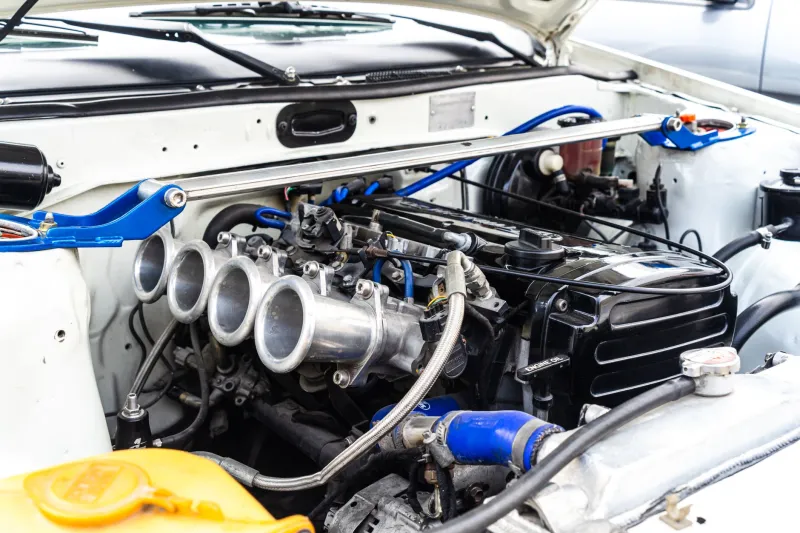
High Risk: ECU tunes, forced induction upgrades, pulley swaps, methanol injection, internal engine work. These are the mods that directly alter how the drivetrain operates. They're also, not coincidentally, where the biggest power gains live. If you go this route on a car still under factory warranty, you need to be strategic.
How Smart Builders Actually Work Around It
The enthusiasts who manage to build serious cars without torching their coverage aren't doing anything illegal or deceptive — they're just methodical.
They stage their builds. Plenty of experienced builders will run a car fully stock through its warranty period, then unleash the build list once coverage lapses or they've transitioned to a third-party extended warranty that's modification-friendly. It takes patience, but patience is cheaper than a denied engine replacement.
They use CARB-compliant or OEM-approved parts where possible. Some manufacturers — GM Performance, Ford Performance, Mopar — sell power-adding accessories that are specifically designed not to void factory warranties. These programs exist. They're not always the most aggressive option, but they're bulletproof from a coverage standpoint.
They document everything. Receipts, installation dates, part numbers, dyno sheets showing responsible tune targets — all of it goes into a folder. If a warranty dispute ever comes up, the burden of proof shifts significantly when you can show that your mods were thoughtfully selected and professionally installed.
They build relationships with dealer service advisors. This sounds soft, but it's genuinely useful. A service advisor who knows you, knows your car, and knows you're not an idiot is going to handle a warranty claim very differently than one who sees a slammed Camaro with a hood scoop and assumes the worst.
They know when to remove the tune. Some ECU tuning solutions — certain Cobb Accessport configurations, for example — allow you to flash back to a stock tune before a service visit. Whether or not this is something you're comfortable with ethically is a personal call. But it's a real thing people do, and dealers are generally aware of it.
When It's Worth the Risk
Honestly? Sometimes it just is. If you're building a dedicated track car, the warranty conversation becomes almost academic — you're going to void it eventually and you probably know that going in. If you're daily driving a $90,000 sports car and planning to keep it through the full warranty period, the calculus is different.
The smartest approach is to be honest with yourself about what kind of builder you are, what kind of car you have, and what you're actually trying to accomplish. A stage-one intake and a mild tune on a $40,000 performance sedan is a different conversation than a built motor and a centrifugal supercharger on a brand-new GT500.
Know the law. Know your mods. Know your risk tolerance. And for the love of everything, keep your receipts.
The power is out there. So is the paperwork that protects your right to chase it.