Stopping Is the New Going Fast: The Case for Upgrading Your Brakes Before Anything Else
There's a ritual every performance enthusiast knows by heart. You pull up a dyno chart, start dreaming about boost pressure, and spend three hours on forums debating whether an extra 40 horsepower is worth the price of admission. It's basically a sport at this point.
What almost nobody talks about with that same energy? Brakes.
And that's a problem — because physics doesn't care about your horsepower number. It cares about whether you can actually control the machine you've built.
The Part of the Equation Nobody Wants to Talk About
Here's a humbling little truth about performance driving: the faster you go, the more critical your ability to slow down becomes. That's not a metaphor. It's straight-up kinetic energy math.
Kinetic energy increases with the square of your velocity. So when you go from 60 mph to 120 mph, your stopping distance doesn't just double — it quadruples. Your brakes have to absorb and dissipate all of that energy, converting it into heat through friction. The harder you push a car, the more heat your brake system has to manage, and the faster that system can fall apart if it's not up to the task.
Brake fade — that terrifying moment when your pedal goes soft and the car just... doesn't slow down the way it should — happens when your brake fluid boils or your pads overheat and lose their friction coefficient. It can hit during an aggressive track session, on a long mountain descent, or even during repeated hard stops on a canyon road. And when it happens at 110 mph, you're not thinking about your horsepower number anymore.
The Typical Build Order Is Backwards
Most enthusiasts build their cars in this order: engine first, suspension second, brakes... eventually, maybe, if there's money left over.
That's backwards. And it's not just a safety lecture — it's a performance argument.
If you can't brake later and harder than the next guy, you're giving up time on every single corner. Professional racing drivers will tell you that the ability to brake deep into a turn — to carry more speed and shed it at exactly the right moment — is one of the biggest performance differentials between drivers and between cars. Your 500-horsepower engine is only useful if you can deploy it confidently, and confidence comes from knowing your brakes won't betray you.
Adding power to a car with stock brakes is like putting a bigger engine in a boat with a broken anchor. Sure, you're moving faster. But good luck when you need to stop.
What Actually Wears Out and Why
Stock brake systems are engineered to handle the car as it left the factory — specific weight, specific power output, specific driving patterns. The moment you start modifying that equation, you're asking more from hardware that wasn't designed for it.
The four main points of failure in a stressed brake system:
Brake pads — Stock pads are typically semi-metallic or organic compounds optimized for daily driving comfort and low dust. Under sustained high heat, they glaze over or crumble. Performance pads use higher-temp compounds that maintain friction where stock pads quit.
Brake fluid — This is the sneaky one. Standard DOT 3 fluid has a dry boiling point around 401°F. Sounds like a lot until you realize aggressive driving can push caliper temps well past that. Boiled fluid compresses, and a compressible fluid means a soft, unresponsive pedal. DOT 4 and DOT 5.1 fluids offer significantly higher boiling points for serious applications.
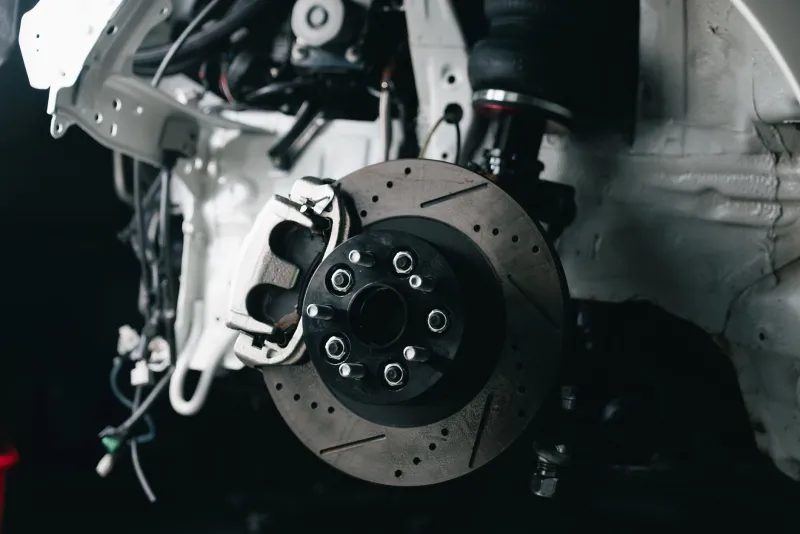
Rotors — Stock rotors are fine for commuting. Under repeated hard braking, they warp, crack, or develop uneven wear patterns that cause vibration and inconsistent bite. Slotted or drilled rotors help manage heat and gas buildup, though for track use, quality two-piece floating rotors are the real move.
Calipers — More pistons, better clamping force. Big brake kits with multi-piston calipers improve pedal feel, reduce flex, and spread heat more evenly across the pad surface.
Matching Your Brake Upgrade to Your Power Level
Not every build needs a full race-spec brake kit. Here's how to think about it by tier:
Street-Driven, Mildly Modified (Up to ~450 WHP)
If you're running bolt-on mods and the car mostly sees highway miles and the occasional spirited canyon run, a quality pad-and-rotor swap gets you most of the way there. Look at brands like EBC, Hawk, or StopTech for street/track compound pads, and upgrade your fluid to a quality DOT 4 like Motul RBF 600. It's affordable, it's effective, and it's a massive upgrade over stock without touching your daily drivability.
Serious Street and Occasional Track Days (~450–600 WHP)
At this level, you need to think about the whole system. A big brake kit — think 355mm or larger rotors with 4-piston or 6-piston calipers — starts making real sense. Wilwood and Brembo both offer excellent bolt-on solutions for most popular platforms. Switch to stainless steel braided brake lines for a firmer pedal feel and upgrade to DOT 5.1 or a dedicated track fluid like Castrol SRF.
Full Send: Track-Built or High-Horsepower Builds (600 WHP+)
At this tier, you're living in a different world. Carbon-ceramic rotors, if budget allows, offer incredible heat resistance and weight reduction. Two-piece floating rotors minimize thermal expansion issues. Full race-compound pads (Pagid, PFC, Carbotech) are the standard. You'll also want to think about brake cooling ducts to channel airflow to the rotors, because at this power level, you're generating heat that passive dissipation alone can't handle.
The Real-World Scenarios That Make the Case
Think about the guy who just bolted a supercharger onto his Mustang GT and is now running 550 horsepower through stock Brembo brakes. Those brakes were spec'd for a 460-horsepower car. On the street, maybe he never notices. But take him to a track day, run three or four hot laps, and watch what happens when he goes for the brakes at the end of the back straight. That's when stock becomes a liability.
Or consider a spirited run down a winding mountain highway — the kind of road that makes car ownership feel worth every penny. Three or four miles of downhill switchbacks with repeated hard braking will heat up stock pads and fluid to a point where fade becomes a real possibility. That's not a track scenario. That's a Tuesday afternoon in the Appalachians or the Angeles Crest.
The Bottom Line
Horsepower gets the headlines. It's flashy, it's quantifiable, and it feels great to talk about. But the drivers who are actually fast — the ones who are fast safely and consistently — know that stopping power is the foundation everything else is built on.
Brake upgrades aren't just a safety checkbox. They're a performance multiplier. They let you brake later, carry more speed into corners, and drive with the kind of confidence that makes a fast car actually fast to drive.
So next time you're sketching out your build list, do yourself a favor: move the brakes to the top. Your lap times — and your guardrails — will thank you.