Wrench Ready: Building a Serious Home Performance Shop Without Emptying Your Savings
Let's be real — shop labor rates are brutal. Sixty, eighty, sometimes over a hundred dollars an hour at a performance specialist means that even straightforward jobs can run into serious money fast. Building your own workspace isn't just satisfying, it's genuinely one of the smartest financial moves a performance car owner can make. But there's a right way and a wrong way to go about it, and buying a bunch of cheap tools you'll curse every time you use them is firmly in the wrong column.
Here's how to build a home performance shop that actually works, starting from scratch and scaling intelligently.
Start With the Foundation: Lifting Equipment
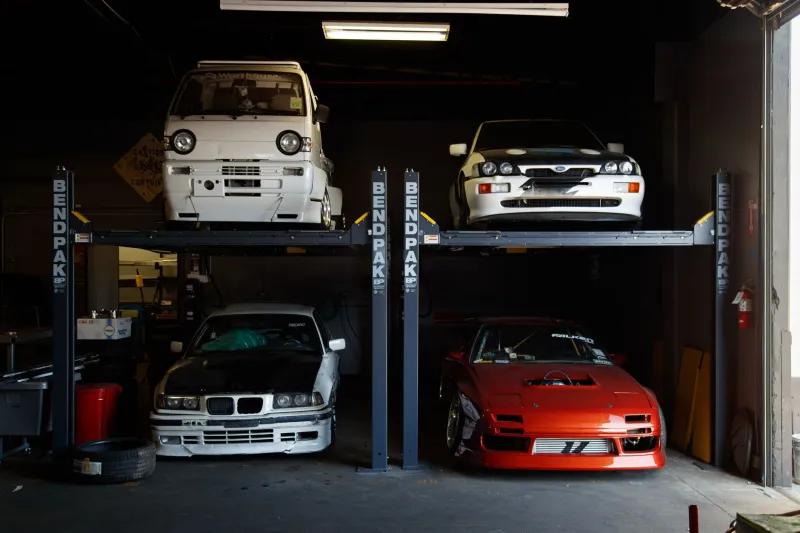
If there's one purchase that separates a real shop from a glorified parking spot, it's a quality lift or jack setup. A full two-post lift is the dream, but it requires ceiling height (typically 11 feet minimum), a concrete floor rated for the load, and a 220V electrical circuit. If your garage checks those boxes, a mid-rise two-post lift from a brand like BendPak or Challenger runs $3,000–$5,000 and will change your life permanently. The ability to walk under your car and work at standing height is not something you can put a price on after you've experienced it.
If a full lift isn't in the cards, don't settle for the cheap scissor jack that came with your car. A quality floor jack — something from Sunex, Arcan, or even the professional-grade Harbor Freight Pittsburgh line — combined with a set of sturdy jack stands rated for your vehicle's weight is a solid starting point. Budget $300–$500 for a jack and stands you can actually trust. Your spine will thank you.
Low-profile racing jacks are worth the premium if you're working on anything with aggressive aero or lowered suspension. Trying to get a standard jack under a slammed hatchback is a comedy of errors you only want to experience once.
The Tool Hierarchy: What to Buy First
Here's the mistake most people make: they go wide instead of deep. Buying a 450-piece socket set from a discount bin sounds impressive until you're rounding off fasteners because the chrome vanadium is softer than the bolts you're working on. Go deep on quality in the tools you'll use constantly, and fill in the gaps over time.
Priority One: A quality ratchet and socket set. Snap-on is the gold standard, but Gearwrench and Tekton offer genuinely professional-grade tools at a fraction of the price. Get both metric and SAE coverage, and make sure you have 3/8" and 1/2" drive options. Performance cars love metric, but American iron still throws SAE at you constantly.
Priority Two: A torque wrench. Or two, honestly. A 1/4" drive for delicate fasteners and a 1/2" drive for suspension and drivetrain work. Snap-on makes excellent ones, but CDI and Precision Instruments offer great alternatives. Never guess on torque specs for performance components — that's how you crack heads and strip threads.
Priority Three: An impact wrench. A quality cordless impact from Milwaukee or Makita will handle the vast majority of what you need. For stubborn lug nuts and suspension bolts, nothing else comes close. If you're doing heavy drivetrain work regularly, a corded pneumatic impact has more sustained power, which means you'll also need an air compressor.
The Air Compressor Question
A good air compressor opens up a massive range of tools and capabilities — impact guns, ratchets, blow guns for cleaning, and eventually paint guns if you go that route. For a home shop, a 60-gallon upright compressor with at least a 5.5 CFM rating at 90 PSI is the sweet spot. Brands like California Air Tools make quieter models that won't drive your neighbors insane at 8 AM on a Saturday, which matters more than you'd think.
Run your air lines along the ceiling and drop them where you need them — it keeps your floor clear and makes the shop dramatically more functional. Quick-connect fittings on everything means tool swaps take seconds.
Smart Space Solutions
Most of us aren't working in a 4-car dream garage. Two-car garages, single-car garages, and even large driveways can be made to work with some creative thinking.
Wall-mounted storage is your best friend. French cleat systems let you rearrange tool organization infinitely and keep everything at eye level and reachable. A good set of rolling tool chests handles your hand tools, but wall space handles everything else — fluids, parts bins, specialty tools, and shop manuals.
A fold-down workbench is worth its weight in gold in tight spaces. When you're not using it, it disappears against the wall. When you need it, you've got a solid work surface without permanently sacrificing floor space.
If you're doing engine work, a cherry picker (engine hoist) and engine stand are essential. Both fold up reasonably compact and can be stored in a corner when not in use. A good hoist from OTC or Torin runs $300–$500 and is infinitely reusable.
Electrical and Lighting: Don't Cut Corners Here
Bad lighting makes everything harder and more dangerous. LED shop lights are cheap, bright, and energy-efficient — run them across your entire ceiling and add a portable LED work light or two for under-car work. You want shadows eliminated, not managed.
If you're planning to run a lift or a welder, you need a 240V circuit. Hire a licensed electrician for this — it's not the place to DIY unless you're already qualified. A dedicated 20-amp circuit for your compressor is also smart, keeping it from tripping breakers when you're mid-job.
The Tools That Pay for Themselves
A quality OBD-II scanner that goes beyond basic code reading — something like the Autel MaxiSys or Launch X431 — saves you diagnostic shop visits constantly. Performance cars throw codes for reasons that cheap $30 scanners can't decode, and knowing what you're actually dealing with before you start pulling things apart is invaluable.
A set of good quality pry bars, a pickle fork set, and a ball joint press will handle most suspension work without destroying parts. A bearing press kit rounds out the drivetrain capability. These aren't glamorous, but they're the tools that let you do the jobs that actually cost serious money at a shop.
Build It Over Time
The biggest mistake in home shop building is trying to do it all at once. Start with the essentials, do some jobs, figure out what you're actually missing, and add from there. Every tool purchase should solve a specific problem you've already encountered — not a hypothetical one.
The goal isn't to have the most impressive garage on Instagram. It's to have a functional, safe workspace where you can do real work on real performance cars. Build that, and the passion follows naturally.