Stop to Win: The Brake Upgrades That Actually Make You Faster
Here's a truth that doesn't get nearly enough airtime in the performance world: going fast is only half the equation. The other half—the half that keeps you alive and shaves real seconds off your lap times—is stopping. Yet walk into any build thread, any shop, any YouTube channel, and you'll see enthusiasts dumping thousands into turbos, intakes, and ECU tunes while rolling on stock brakes that were designed for a daily commute to the office.
That's backwards. And if you're serious about performance, it's time to fix it.
The Hierarchy Nobody Talks About
Brake systems have a pecking order, and understanding it changes how you spend your money. At the base level, you've got brake fluid. Above that, pads. Then rotors. Then calipers. Most people jump straight to the shiny stuff—slotted rotors, big brake kits with six-piston calipers—without addressing the fundamentals first. That's like bolting a supercharger onto an engine with a cracked head gasket.
Start with fluid. This is where performance brake systems live or die, especially under hard use. Stock brake fluid—typically DOT 3 or DOT 4—has a relatively low boiling point. When you're hammering a canyon road or doing back-to-back track laps, heat builds up fast. Once your fluid boils, you've got vapor in the lines, and vapor doesn't compress the way fluid does. The result is a soft, spongy pedal right when you need firm, confident braking the most. That's called brake fade, and it's terrifying.
Upgrading to a high-performance DOT 4 or DOT 5.1 fluid—something like Motul RBF 660 or ATE Super Blue—raises your wet boiling point dramatically. We're talking the difference between a wet boiling point of around 284°F on stock fluid versus 400°F-plus on a racing-spec blend. For under $20 a bottle, it's the highest-value brake upgrade in existence. There is no argument.
Pads: The Contact Patch That Changes Everything
Once your fluid situation is sorted, pads are the next logical step. This is where driving scenario matters enormously. Street-only drivers and track-day warriors have completely different needs, and running the wrong compound in the wrong context will either destroy your rotors prematurely or leave you with pads that need 15 minutes of heat cycles before they bite properly.
For street-focused performance builds, a high-performance street pad—think Hawk HPS, EBC Yellowstuff, or Stoptech Street Performance—gives you improved bite and better heat resistance without the cold-bite penalty of a full race compound. These pads work from the first pedal press, which matters on public roads where you don't get a warm-up lap.
For track days or autocross, step up to a dedicated track compound. Hawk DTC-60, Carbotech XP10, or PFC 08 compounds are engineered to perform at elevated temperatures. They'll feel wooden and grabby on a cold street commute, but once they're in their operating window on a circuit, the difference in pedal confidence and modulation is night and day. Just plan on replacing them more often—track pads eat themselves faster than street compounds.
Rotors: Function Over Flash
Here's where a lot of builders get seduced by aesthetics over engineering. Drilled rotors look incredible. They're also more prone to cracking under repeated thermal stress than slotted or plain rotors, particularly in high-heat applications. Slots serve a legitimate purpose—they help vent gas and debris from the pad surface, maintaining consistent contact. Plain rotors, especially in quality iron like Brembo OE or DBA 4000 series, are often the best choice for daily-driven performance cars.
Sizing matters too. Larger diameter rotors increase the leverage arm, improving braking torque without requiring additional clamping force. But you need clearance inside your wheels, and you may need new calipers to match. Don't upsize rotors in isolation without thinking through the full system.
Big Brake Kits: Worth It or Overkill?
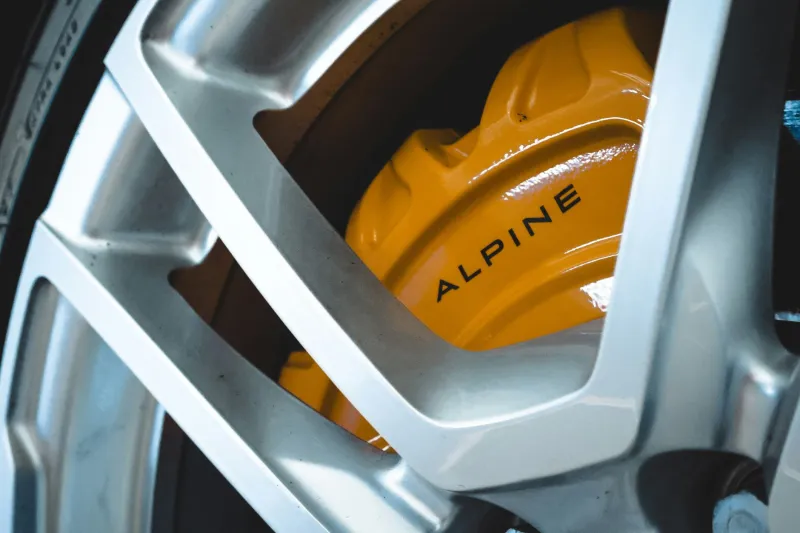
Big brake kits—multi-piston calipers, oversized rotors, stainless lines—are the headline act of brake upgrades, and they can be genuinely transformative for the right application. A six-piston caliper with a 380mm rotor on a 600-horsepower track car makes total sense. On a 300-horsepower street car that sees occasional canyon runs, it's probably overkill and could actually degrade pedal feel if the system isn't properly balanced front to rear.
The real advantage of big brake kits isn't raw stopping power—most factory systems can already exceed the grip limits of the tires. The advantage is heat management and fade resistance. More rotor mass means more thermal capacity. Better calipers mean more consistent pad contact and less flex. For drivers who push their cars hard and repeatedly, that consistency is everything.
Budget realistically. A quality big brake kit from Brembo, StopTech, or AP Racing starts around $1,500 for a front setup and climbs quickly from there. Add installation, fresh fluid, and matched pads, and you're looking at $2,000-plus. It's not cheap—but it's cheaper than a guardrail.
What the Dyno Sheet Doesn't Show
This is the thing about brake upgrades that makes them so easy to overlook: they don't show up on a dyno. You can't point to a printout and say "I picked up 40 stopping feet." But on a real road or a real track, the gains are absolutely measurable. Shorter braking distances let you carry speed longer before trail-braking into a corner. Consistent pedal feel lap after lap means you can push harder with confidence. And in an emergency situation on the street, upgraded brakes aren't just a performance advantage—they're a survival advantage.
Every serious performance build deserves a serious brake system. The next time you're allocating your mod budget, put brakes at the top of the list. The horsepower will still be there waiting for you once you've handled what actually matters.