Sip, Don't Chug: How Smart Performance Builds Are Winning the MPG Battle
Ask any weekend warrior at a car meet whether their build kills at the pump and you'll usually get a shrug, a grin, or some variation of "yeah, but it rips." The assumption has always been baked in: more power equals more fuel. It's practically gospel in the enthusiast world. But here's the thing—that gospel is getting rewritten, and the people doing the rewriting are tuners, engineers, and everyday gearheads who refused to accept the trade-off.
The reality in 2024 is that performance and efficiency aren't the enemies they used to be. If you're building smart and tuning with intention, you might be surprised at what your fuel gauge actually says at the end of a long highway pull.
Where the Myth Comes From
It's not like the old reputation came out of nowhere. Carbureted muscle cars from the '60s and '70s genuinely did drink fuel like it was going out of style. Big-block V8s running primitive fuel delivery systems had no real mechanism for efficiency—they were tuned to run rich because lean was dangerous and detonation was a real threat. So yeah, 10 miles per gallon wasn't unusual, and nobody complained much because gas was cheap and nobody was counting.
Fast forward a few decades, and the muscle car mythology stuck even as the technology evolved dramatically. People still assume a built motor means a thirsty motor. But modern engine management systems, direct injection, variable valve timing, and advanced turbocharging have fundamentally changed what's possible.
The Technology That Changed Everything
Let's talk about the hardware side first. Direct injection, which meters fuel directly into the combustion chamber rather than the intake port, dramatically improves combustion efficiency. When you're running a modern turbocharged four-cylinder or a sophisticated V6 with DI, you've already got a foundation that's inherently more efficient than older technology—even before any tuning touches it.
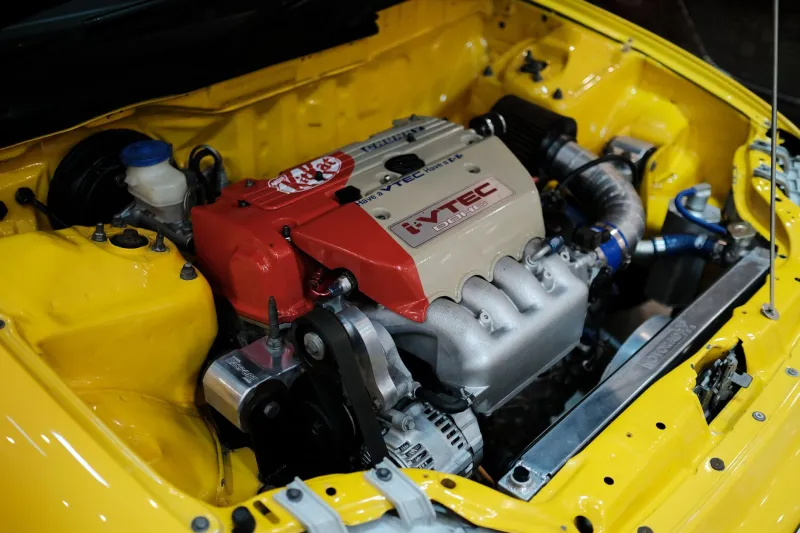
Variable valve timing (VVT) and variable valve lift systems like Honda's VTEC or BMW's Valvetronic allow an engine to essentially behave differently depending on load. Under light cruise conditions, the engine can run a more conservative cam profile. When you put your foot down, it opens up. That's efficiency and performance coexisting in the same hardware package.
Turbocharging is arguably the biggest efficiency enabler of all. A smaller displacement turbocharged engine can produce big-block power numbers while sipping fuel during normal driving because it's only making that power on demand. Ford's EcoBoost platform proved this to mainstream buyers. The enthusiast community has been exploiting it even harder with bolt-on turbos and upgraded intercoolers that let them push output significantly higher without trashing everyday drivability.
Tuning for Both Ends of the Tachometer
This is where things get genuinely interesting. Modern ECU tuning platforms—whether you're running a Cobb Accessport, an HP Tuners setup, or a custom tune from a reputable shop—give tuners the ability to write maps that are aggressive at wide-open throttle while staying conservative during part-throttle cruising.
A skilled tuner can optimize fuel trims, ignition timing, and boost pressure curves so your engine isn't throwing fuel at the combustion chamber when you're just rolling down the interstate at 70 mph. The aggressive stuff lives at the top of the rev range and the upper end of the throttle position. The rest of the time, the engine can run leaner, cleaner, and more efficiently than stock if the tune is done right.
Some enthusiasts have actually reported better fuel economy after a quality tune compared to factory maps, particularly on platforms where the OEM tune was conservative to the point of being slightly inefficient. That's not marketing spin—it's the result of removing unnecessary fuel enrichment that the factory added as a safety buffer.
Real-World Data From Real Builds
Look at any popular platform-specific forum—Subaru WRX, Ford Focus ST, Volkswagen GTI, Chevrolet Camaro SS—and you'll find threads where owners track fuel economy after modifications. The pattern that emerges is consistent: bolt-on intake and exhaust combined with a responsible tune rarely destroys economy. Many owners report staying within one to two miles per gallon of stock figures while picking up meaningful power.
The builds that crater fuel economy are usually the ones chasing maximum output without regard for anything else. Massive injectors running at high duty cycles, aggressive fueling maps pushed to their limits, and setups designed purely for track use will drink fuel. But that's not a flaw of performance modification in general—it's the predictable result of optimizing for one variable exclusively.
The Mods That Hurt vs. The Mods That Help
Not all performance parts are created equal from an efficiency standpoint. A cold air intake that actually improves airflow and combustion efficiency can be a net positive. A quality cat-back exhaust that reduces back pressure lets the engine breathe easier, which can help efficiency at part throttle. Lightweight wheels reduce rotating mass, which means less energy required to accelerate and maintain speed.
On the flip side, supercharger kits running at high boost levels, big camshaft upgrades that sacrifice low-end efficiency for top-end power, and fuel system upgrades designed for race-level output will all take a toll at the pump. The key is knowing what you're building toward and making intentional choices rather than just bolting on everything the catalog offers.
The Mindset Shift
Maybe the most important change isn't technical—it's mental. Enthusiasts who approach a build with efficiency as one of their goals alongside power tend to make smarter, more cohesive choices. They're not just chasing peak horsepower numbers. They're thinking about the entire power curve, about how the car behaves during the 95 percent of driving that isn't a full-send blast.
That mindset produces builds that are genuinely more livable, more versatile, and honestly more impressive. Anyone can throw money at a car until it makes big numbers. Building something that's fast and reasonable at the pump? That takes actual thought.
The fuel economy myth is fading. Efficient performance isn't a compromise—it's the new benchmark for a build done right.